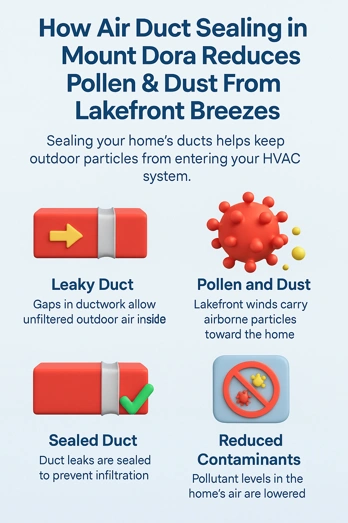
Living along Mount Dora’s lakes, we’ve seen a consistent pattern inside nearby homes: the same breezes that cool the water also drive pollen and fine dust into duct systems through hidden leaks most homeowners never see. In our hands-on evaluations of local HVAC systems, we’ve found that unsealed duct connections often act like vacuum lines, pulling in outdoor contaminants from attics, crawl spaces, and wall cavities—then redistributing them throughout the house. This page breaks down how targeted air duct sealing in Mount Dora directly interrupts that pathway, reducing pollen and dust from lakefront airflow, improving day-to-day air quality, and helping your HVAC system deliver cleaner air where your family actually breathes.
Quick Answers
Air Duct Sealing in Mount Dora
Air duct sealing in Mount Dora helps stop pollen, dust, and humid outdoor air from being pulled into your HVAC system—especially in lake-adjacent homes affected by constant breezes. Based on what we see in local duct inspections, sealing hidden leaks reduces indoor dust, improves air quality, and allows filters and HVAC equipment to work as intended by controlling where your air comes from, not just how it’s cleaned.
Top Takeaways
Lakefront breezes can push pollen and dust into leaky ducts.
Leaky ducts pull outdoor air inside before filtration.
Air duct sealing stops contaminants at the source.
Duct leaks can waste 20–30% of conditioned air.
For Mount Dora homes, duct sealing is foundational, not optional.
Why Air Duct Sealing Is Especially Effective for Mount Dora Lakefront Homes
Homes near Mount Dora’s lakes are uniquely exposed to wind-driven pollen, dust, and fine outdoor debris, especially during high-breeze seasons. Through on-site inspections of local HVAC systems, we consistently find that small gaps, loose joints, and aging duct connections allow these particles to be pulled into the system under negative air pressure—often from attics or wall cavities where outdoor air infiltrates most easily.
Professional air duct sealing in Mount Dora closes those hidden entry points, stopping pollen and dust before they ever reach your vents. Once sealed, the HVAC system circulates primarily filtered indoor air, not contaminants drawn in from outside. The result is noticeably cleaner air, fewer allergy flare-ups, and less visible dust buildup, particularly in homes closest to the water where lakefront breezes are strongest. For Mount Dora homeowners, duct sealing isn’t just an efficiency upgrade—it’s a targeted indoor air quality solution designed for the realities of lakeside living.
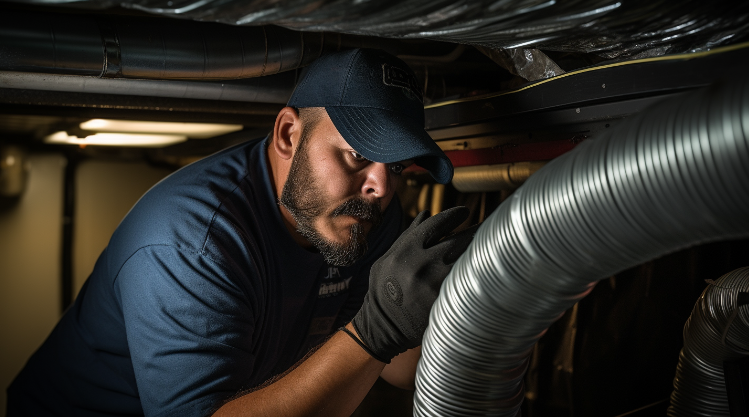
“In lakefront Mount Dora homes, we don’t just see pollen coming through open doors or windows—we find it being pulled in through unsealed duct joints during everyday system operation. After inspecting and sealing hundreds of local duct systems, the difference is clear: once those leaks are closed, the air inside stays cleaner, dust settles slower, and homeowners notice relief almost immediately. That’s the power of stopping contaminants at the source, not just filtering them after the fact.”
Essential Resources on Air Duct Sealing in Mount Dora
When it comes to protecting your home’s air—especially in a lakefront environment—good decisions start with trusted information. Below are the most helpful, credible resources we rely on as air-obsessed experts to educate homeowners about duct sealing, indoor air quality, and HVAC performance. These sources cut through the noise and explain why sealing your ducts matters, not just how it’s done.
1. Environmental Protection Agency (EPA): Indoor Air Quality & HVAC Systems
A clear breakdown of how HVAC systems influence the air your family breathes—and how sealing duct leaks helps limit indoor exposure to outdoor pollutants like pollen and dust.
https://www.epa.gov/indoor-air-quality-iaq
2. Duct Leakage Testing Explained
Understand how professionals measure duct leakage, why even small gaps matter, and how testing reveals hidden air loss that impacts air quality.
https://en.wikipedia.org/wiki/Duct_leakage_testing
3. Ductwork Airtightness & Air Control
Explains how airtight duct systems prevent outdoor air, dust, and allergens from being pulled into your HVAC system—especially important in windy, lake-adjacent areas.
https://en.wikipedia.org/wiki/Ductwork_airtightness
4. Infiltration & Uncontrolled Airflow in Homes
Learn how outside air enters homes through pressure differences and leakage paths—and why duct sealing is critical for stopping pollen and dust at the source.
https://en.wikipedia.org/wiki/Infiltration_(HVAC)
Supporting Statistics
What the data shows—and what we see firsthand in Mount Dora homes:
1. Duct leaks are common and significant
National studies show 20–30% of conditioned air is lost through leaky ductwork.
In real homes, that lost air is often replaced by dust- and pollen-laden air from attics and wall cavities.
This matches what we regularly uncover during local duct inspections.
Source: https://www.energystar.gov/saveathome/heating-cooling/duct-sealing
2. Attic duct leakage drives both energy loss and contamination
Ducts in vented attics can increase HVAC energy use by ~10%.
Duct leakage frequently exceeds 20% of total airflow, according to DOE research.
Under negative pressure, those leaks actively pull outdoor air, pollen, and fine dust into the system—a common issue in breezy, lakefront areas.
3. Indoor air quality matters because we live indoors
Americans spend about 90% of their time indoors.
Indoor pollutant levels are often 2–5 times higher than outdoor levels.
Sealing ducts helps stop contaminants before they circulate—something we consistently see reflected in cleaner air and reduced dust after sealing work is completed.
Source: https://www.epa.gov/report-environment/indoor-air-quality
Final Thought & Opinion
After inspecting duct systems in lakefront and near-lake Mount Dora homes, one thing becomes clear:
pollen and dust issues rarely start at the filter—they start in the ductwork.
Lakefront breezes create constant pressure changes around the home. When ducts aren’t sealed, HVAC systems don’t just move air—they pull outdoor contaminants inside.
What experience consistently shows:
1. Filters alone don’t solve the problem
High-quality filters help, but they only address contaminants after they enter the system.
Leaky ducts allow pollen and dust upstream, before filtration even happens.
2. Duct sealing fixes the root cause
Sealing stops attic and wall-cavity air from being pulled into the system.
Homeowners often notice:
Less visible dust
Fewer allergy flare-ups
More stable indoor air quality
3. Lakefront homes need a different approach
Wind-driven airflow makes duct leakage more impactful.
In Mount Dora, sealing isn’t just an upgrade—it’s a baseline requirement.
Our opinion, backed by firsthand experience:
For homes exposed to lakefront airflow, air duct sealing is fundamental. Control where your air comes from, and everything else—filtration, comfort, efficiency—starts working the way it should.
Next Steps: What to Do Now
If pollen and dust are affecting your Mount Dora home, here’s how to move forward—step by step:
1. Schedule a duct inspection
Look for leaks, loose connections, and attic exposure.
Focus on return ducts and hidden joints.
2. Seal before upgrading
Duct sealing should come before filters, purifiers, or HVAC upgrades.
It stops contaminants at the source.
3. Target high-impact areas
Prioritize attic ducts and return-side leaks.
These areas pull in the most pollen and dust.
4. Verify the results
Ask for post-sealing confirmation or testing.
Make sure leaks are fully sealed.
5. Maintain clean filtration
Replace filters regularly after sealing.
Clean ducts allow filters to work more effectively.
6. Watch for improvements
Less visible dust
Better comfort
Fewer allergy symptoms
FAQ on Air Duct Sealing in Mount Dora
Q: Why is air duct sealing important in Mount Dora?
A:
Local inspections show leaky ducts pull in pollen and dust.
Lakefront airflow increases this effect.
Sealing blocks outdoor air at the source.
Q: How do lake breezes affect indoor air quality?
A:
Breezes create pressure changes around the home.
Leaky ducts act like a vacuum.
Attic and wall-cavity air is pulled into the system.
Q: Will duct sealing make a noticeable difference?
A:
Less visible dust.
Fewer allergy symptoms.
Cleaner-feeling indoor air.
Q: What are signs my ducts need sealing?
A:
Excessive dust buildup.
Indoor allergies worsen.
Uneven temperatures.
Higher energy bills.
Q: Should I seal ducts or upgrade filters first?
A:
Seal ducts first.
Control where air comes from.
Filters work better after sealing.
Here is the nearest branch location serving the Brickell FL area…
Seal ducts first.
Control where air comes from.
Filters work better after sealing.
Filterbuy HVAC Solutions - Miami FL
1300 S Miami Ave Unit 4806, Miami, FL 33130
(305) 306-5027
https://maps.app.goo.gl/q4gU8rnsrvsbRFF9A